
Data from the EU Eurofound “Quality of Life in the EU 2024” survey and report will (and should) spark discussions about the state of remote work in Europe. Headlines may focus on a decline in fully remote jobs across the bloc, but a closer look at the data reveals a different and a much more promising story for Ireland.
Rather than signalling a downturn, Ireland’s place in the future of work and competitiveness within the EU is instead one to celebrate. The the findings also highlight a further major untapped opportunity for Ireland’s economy.
A Critical Distinction: What This Data Really Measures
The Eurofound report firstly states that as of 2024 across the EU:
- 33% of jobs are remote or hybrid
- 24.5% were hybrid
- 8.5% were fully remote
These figures do indeed reflect a decline from 2023 numbers (38%), but again they are consolidated across Europe and do not capture the full picture – nor do they reflect the current reality specific to Ireland.
The report then goes on to breakdown and define that across the EU:
- 14% of “teleworkable” jobs are fully remote
- 44% of “teleworkable” jobs are hybrid
- 41% of “teleworkable” jobs are fully on-site
However, this does not reflect the actual operating models of businesses. Instead, the report counts the proportion of jobs that employees believe can be performed remotely. This is a critical distinction that shifts the conversation entirely.

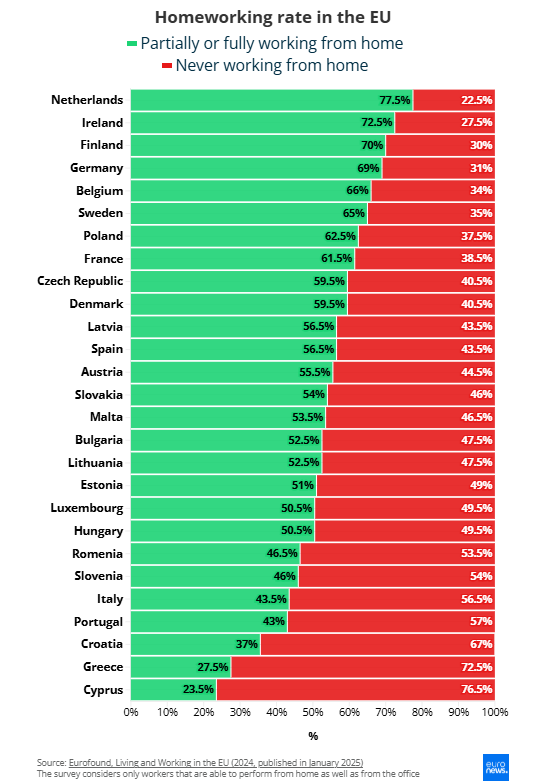
For the country level breakdown of Ireland, the report shows that 72.5% of “teleworkable” jobs are currently performed remotely (either remote or in a hybrid model). This does not mean that nearly three-quarters of Irish workers are remote. Instead, it means that for jobs which people believe are capable of being done remotely, almost three-quarters are – however, 27% are still not.
The Scale of Ireland’s Remote Work Potential
To quantify this opportunity, let’s map these percentages onto real workforce numbers. According to the latest CSO data for Q4 2024:
- CSO Total Employed Workforce: 2,776,400
- CSO Remote Workers: 972,700
We will map this # to the 72% of “teleworkable” jobs per Eurofound report - CSO Non-Remote Workers: 1,791,400
- CSO Not Stated: 120,400
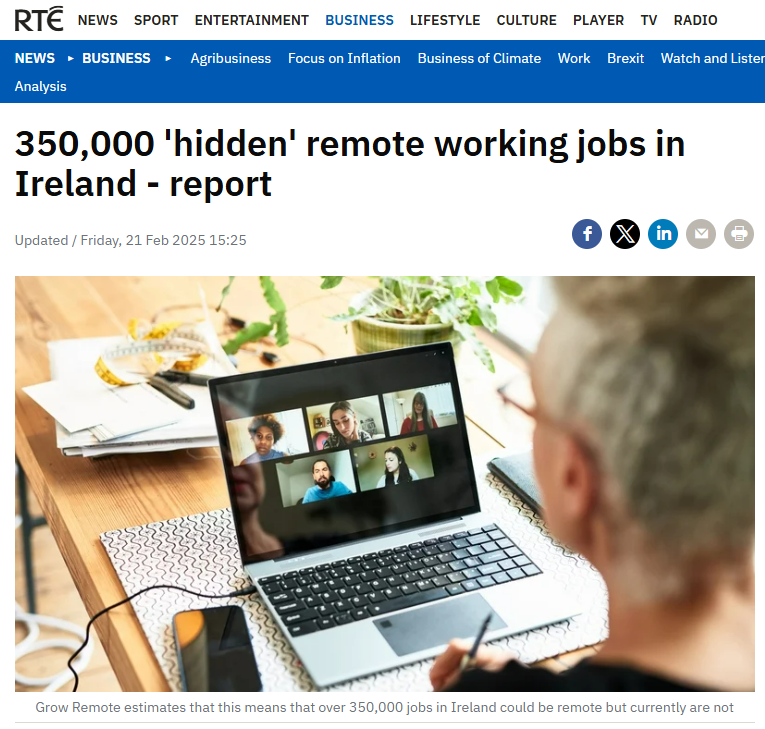
From these figures, we can estimate that around 1,350,000 jobs in Ireland could be remote – but over 350,000 of those are not. These jobs are held back by policies, skills gaps, or a lack of employer support for flexible operating models.
Unlocking 100,000+ More Remote Jobs in Ireland
If Ireland could transition just one-third of these potentially remote jobs to fully remote roles over the next three years, that would mean an additional +100K remote jobs – shifting into more flexible, locationless roles. These are not new jobs as they already exist ones in the Irish workforce. This shift would have a massive ripple effect across Ireland’s economy, society, and environment.
Why not speak about +350K remote jobs? The data is based on what respondents deem is a job that could be done remotely. That can never match up to what an employer thinks or is feasible in terms of transition so we have to allow for that. We also have to allow for the fact that fully remote work is not for everyone, not for every business and nor should it be.
So rather than focus on the theoretical maximum, we focus on a realistic, achievable shift – one-third of the untapped potential.
The Broader Impact of +100K Additional Remote Jobs
1. Social Impact
Studies show that 25% of remote workers volunteer. If just 10% of these 100,000 workers dedicated extra time to community activities, that’s 10,000 more people contributing to GAA clubs, community projects, and social enterprises.
Grow Remote’s Map of Remote finds that:
- 20% of remote workers use saved commute time for fitness and exercise.
- 8% use it for caregiving responsibilities.
2. Economic Boost
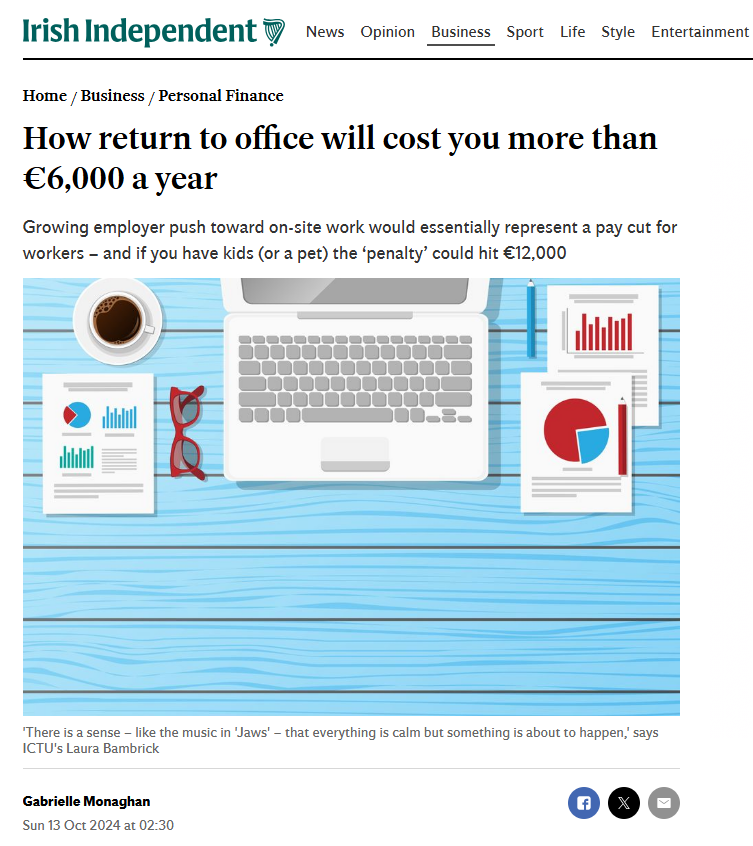
- The estimated cost savings per remote worker: €6,000 per year (commuting, meals, and other expenses).
- For 100,000 additional remote workers, that’s over €600 million in total savings.
- If just 25% of those savings are spent locally, that’s €150 million injected into Irish communities.
- Businesses could also save significantly on office space and operational costs, and utilise local office hubs and the EU benchmark national hub network.
3. Environmental Gains
- Fewer commutes mean lower emissions.
- If 100,000 workers shifted to remote work, Ireland would see a substantial reduction in CO2 emissions.
- If just 25% of these remote workers eliminated their commute, it could remove the equivalent of 700,000 Dublin-to-London flights in CO2 emissions per year. Yes 700K!
- Beyond emissions, reducing congestion in cities improves urban infrastructure sustainability and overall well-being.
In addition to all of this, the social value of +100K jobs being done remotely is also an opportunity to look at things from a different but important value perspective.
Is Remote Work in Decline? The Data Says No for IE.
Despite EU level concerns about a decline in remote work, Ireland’s own data tells a different story:
- CSO Labour Force Survey (2024): 35% of the Irish workforce is remote or hybrid, stable over the last 10 quarters, and 10% higher than pre-pandemic levels.
- Hays Ireland (2024): 45% of professionals are hybrid, 15% are fully remote, and 40% are on-site.
- LinkedIn job postings (Feb 2025): 15% remote, 25% hybrid, 60% on-site.
What Needs to Happen Next?
Ireland has made great strides thanks to government policies, agencies, enterprise support, and infrastructure initiatives, and employers themselves but more can be done:
1) Increasing the Supply of Remote Jobs
Support for Indigenous Employers to Embrace Remote Work:
Government investment in training and support programs for employers would help businesses – especially small and medium-sized enterprises – develop the necessary tools and infrastructure to implement and manage remote work effectively, ultimately expanding the number of remote jobs available in Ireland’s indigenous workforce.
The DETE Making Remote Work strategy acknowledges that dedicated training to support management skills development will be important to enable the successful adoption of remote working (DETE, 2021). However, while 75% of Irish firms had invested in technology to support remote or hybrid working, less than half (41%) of line managers had received training on how to manage remote or hybrid teams (CIPD, 2022).”

Hybrid and remote are now standard operating models and support to thrive within them is available today. Grow Remote’s training programs for individuals such as “Leading Remote & Hybrid Teams” and its industry expert-led workshops for employers such as ‘High-Performing Teams in Digital Workplaces’ are built and delivered to help businesses thrive in the future of work.
Global Remote Jobs Strategy:
Tens of thousands of remote roles are available globally, and Ireland is well-positioned to capture a significant share of this market. By establishing the right structures, Ireland can create a fourth pillar of employment, complementing indigenous companies, foreign direct investment (FDI), and agriculture.
Addressing Demand for Remote Jobs
Building Remote Work Communities:
Grow Remote has highlighted the importance of building vibrant local communities for remote workers, where individuals can engage with each other both professionally and socially. Investing in local remote hubs and communities can serve as a critical support system for remote workers, offering both physical workspaces and social connection opportunities.
Increased Visibility and Accessibility to Remote Jobs:
The Government should invest in creating a centralised platform for remote work that includes job listings, training resources, and information about remote-friendly employers. Greater visibility is essential for job seekers, particularly those from disadvantaged or rural areas, who may not be aware of available remote opportunities.
The points above show, significant progress has been made in Ireland to date, but more support and investment is needed to position Ireland as the global leader in remote work.
Tracy Keogh, Co-founder and Chair of Grow Remote, said of the new Programme for Government:
“The cross party group needs to set up an agency responsible for winning a proportion of the remote jobs available on the market. If we landed 10,000 of the available 100k, that would be €130 million for the taxpayer and jobs in the most remote regions of Ireland. It will require structural changes as we’re not currently set up to drive this. Some EU funding structures don’t incentivise remote. We need quick wins to ring-fence remote jobs to the island of Ireland.“
The Bottom Line
Ireland is already ahead of many European nations in remote work adoption. But the real takeaway from Eurofound’s data isn’t that remote work is disappearing – it’s that there’s still huge untapped potential.
We have the infrastructure, demand, and proof of impact. Now, we need to invest in sustainable growth and the last-mile delivery of distributed work to secure Ireland’s place as an EU and global leader in the future of work.
Grow Remote is available to support businesses, policymakers and communities in making remote work a reality for 100,000 more people across Ireland.